
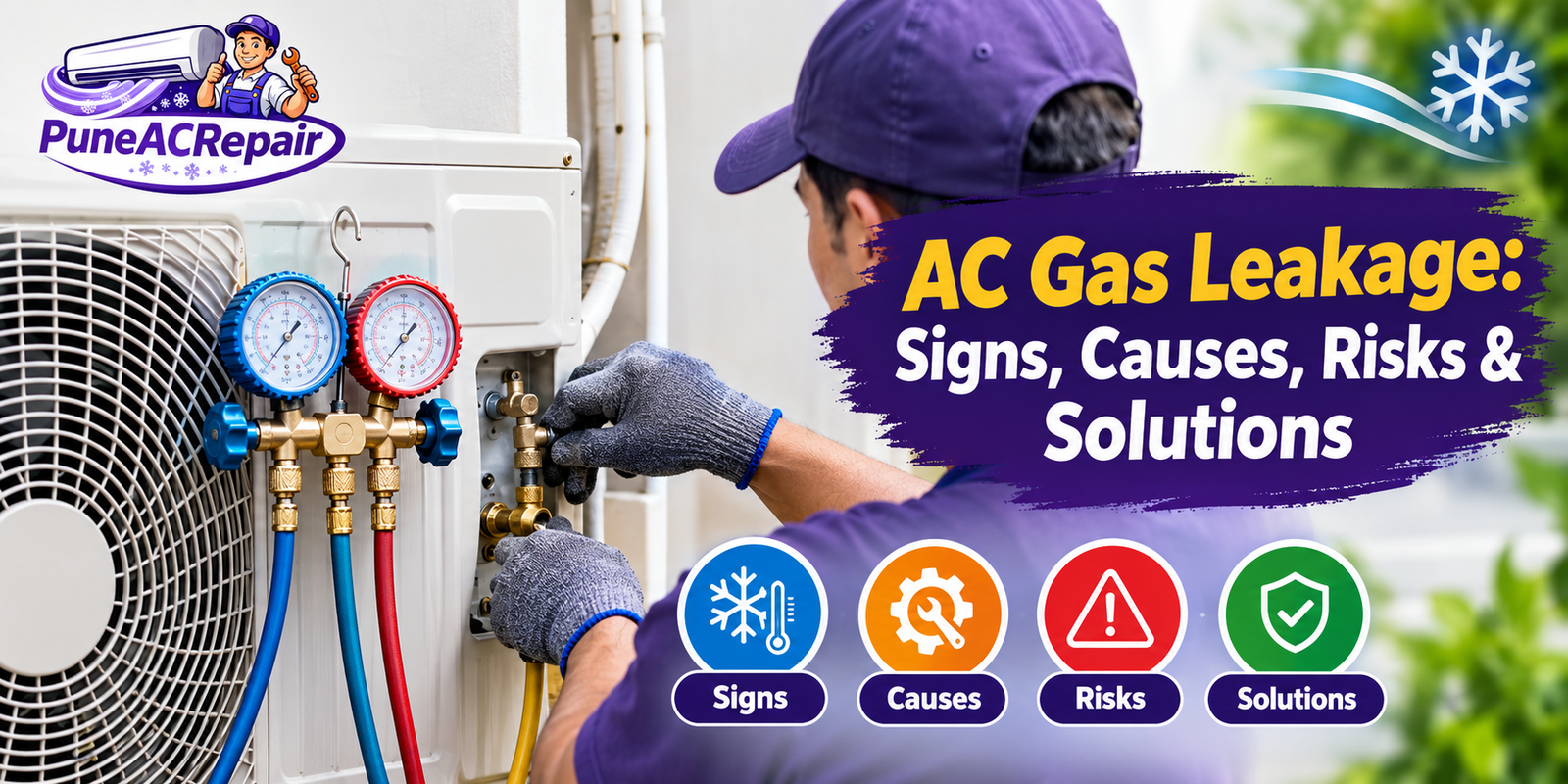
An AC gas leakage can reduce cooling performance and make your air conditioner work harder than normal. If the refrigerant level becomes low, the AC may take longer to cool the room, develop ice on the coil, or keep running without reaching the set temperature.
Refrigerant does not normally get used up like fuel. If the level becomes low, there may be a leak somewhere in the system or another issue that needs to be checked.
In this guide, we explain the common signs, causes, risks and solutions for AC gas leakage, along with how technicians detect and repair the problem.
What Is AC Gas Leakage?
An air conditioner uses refrigerant to absorb heat from indoor air and release it outside. The refrigerant moves through a sealed system containing the compressor, coils, copper pipes and other components.
An AC gas leakage happens when refrigerant escapes from this sealed system through a damaged pipe, loose connection, corroded coil or another weak point.
When refrigerant levels become too low, the AC may not be able to cool the room properly.
Signs of AC Gas Leakage
1. AC Is Not Cooling Properly
Weak cooling is one of the most common signs of an AC gas leakage. The AC may be running normally, but the room may remain warm or take much longer to cool.
However, low cooling does not always mean there is a refrigerant leak. Dirty filters, blocked coils, fan problems and compressor issues can also cause similar symptoms.
For more information, see our guide on why your AC is not cooling properly.
2. Ice on the Copper Pipe or Coil
Low refrigerant pressure can sometimes cause ice or frost to form on the indoor coil or copper pipe.
If you notice ice, do not assume that gas filling is the only solution. The technician should first check why the system is freezing.
3. AC Runs Continuously
An AC affected by AC gas leakage may run for a long time without reaching the desired temperature.
The compressor may continue working because the system is unable to provide the expected cooling performance.
4. Hissing Sound
A small hissing sound near the indoor unit, outdoor unit or copper pipe connections can sometimes indicate refrigerant escaping from the system.
Small leaks may not always produce an audible sound, so professional leak detection may be necessary.
5. Higher Electricity Consumption
When an AC is unable to cool efficiently, it may operate for longer periods. This can contribute to increased electricity consumption.
Higher electricity bills alone do not confirm an AC gas leakage, but they can be considered along with other cooling problems.
Common Causes of AC Gas Leakage
There are several reasons why refrigerant can escape from an air-conditioning system.
Damaged Copper Pipes
Copper pipes can become damaged during installation, movement or repair work. A small crack or hole can allow refrigerant to escape gradually.
Loose Connections
Poorly tightened flare joints or connections can develop leaks over time. Proper installation is important to reduce the possibility of refrigerant loss.
Coil Corrosion
Indoor or outdoor coils can deteriorate over time. Corrosion may eventually create small openings that result in an AC gas leakage.
Vibration and Wear
The outdoor unit and compressor produce vibration during operation. Over time, repeated movement can affect pipes and connections.
Installation Problems
Incorrect pipe connections, poor flare work or improper handling during installation can contribute to refrigerant leakage.
Risks of Refrigerant Gas Leaks in Air Conditioners
An AC gas leakage should not simply be ignored because the AC is still running.
The most obvious problem is reduced cooling. As the refrigerant level falls, the AC may have to operate for longer periods to achieve the required temperature.
An unresolved refrigerant problem can also affect normal system operation and may contribute to additional stress on components.
The safety considerations also depend on the type of refrigerant used in the AC. Different refrigerants have different handling requirements, so it is important to identify the refrigerant before carrying out service work.
If you suspect a leak, it is better to arrange an inspection rather than repeatedly adding refrigerant without finding the cause.
How Is AC Gas Leakage Detected?
Finding the exact location of an AC gas leakage can sometimes be difficult because the leak may be very small.
A technician may inspect:
- Copper pipe connections
- Indoor and outdoor coils
- Valves and joints
- Visible signs around the system
- Refrigerant pressure
- Suspected leak points
Depending on the AC and the suspected problem, technicians may also use specialised refrigerant leak-detection equipment.
A proper inspection helps determine whether the problem is actually a refrigerant leak or another AC fault.
Can You Just Refill the Gas?
Simply adding refrigerant may not permanently solve an AC gas leakage.
For example, if a copper pipe has a small hole and the technician only adds refrigerant, the gas can escape again. This means the AC may start showing the same cooling problem after some time.
The better approach is to identify the source of the leak, repair the affected area where possible, test the system and then recharge it with the appropriate refrigerant.
How is an AC Gas Leak Repaired?
The repair process depends on the location and severity of the leak.
A typical service may include:
- AC inspection – The technician checks the system and cooling performance.
- Leak detection – Suspected pipes, joints, coils and connections are inspected.
- Leak repair – The damaged pipe, connection or component may be repaired or replaced.
- System testing – The system is checked after the repair.
- Vacuuming – The system may be vacuumed as required before charging.
- Refrigerant charging – The correct refrigerant is added according to the AC manufacturer’s requirements.
- Final cooling check – The technician checks whether the AC is operating properly.
This process is more effective than repeatedly topping up refrigerant without finding the source of the problem.
Can AC Gas Leakage Be Prevented?
Not every leak can be prevented, especially when components become old or damaged. However, regular maintenance can help identify problems earlier.
A few simple practices include:
- Keep the indoor and outdoor units clean.
- Get unusual cooling problems checked early.
- Use qualified technicians for installation and repairs.
- Avoid unnecessary movement of copper pipes.
- Do not repeatedly refill refrigerant without checking for a leak.
- Schedule regular AC maintenance.
- Use the refrigerant specified for your AC model.
If your AC repeatedly needs gas refilling, an AC gas leakage or another system problem should be investigated.
AC Gas Filling Service in Pune
If your AC is showing weak cooling, ice formation or other symptoms associated with low refrigerant, professional inspection is recommended.
Our AC gas filling service in Pune includes inspection, leak checking and refrigerant charging based on the AC system’s requirements.
The goal is not simply to add gas but to understand why the refrigerant level is low and provide the appropriate service.
Final Thoughts
An AC gas leakage can lead to weak cooling, longer operating cycles and other AC performance problems. Symptoms such as ice on the copper pipe, poor cooling, unusual hissing sounds or repeated need for gas refilling should be checked properly.
Instead of repeatedly adding refrigerant, the source of the problem should be identified first. Once the leak or other fault is addressed, the system can be tested and charged with the correct refrigerant.
Need help with an AC cooling or refrigerant problem? Contact our AC service team to arrange a service visit.
Frequently asked questions
No. Refrigerant normally circulates inside a sealed AC system. If the refrigerant level becomes low, the system should be checked for a possible leak or another underlying problem.
A gas top-up may provide temporary improvement, but it does not solve the source of the problem if refrigerant is escaping. The leak should be identified and repaired before properly recharging the system.
It is better to have an AC gas leakage checked by a trained technician. Leak detection, pressure testing and refrigerant charging require appropriate equipment and handling procedures.
The risk depends on the refrigerant used, the quantity released and the surrounding conditions. If you suspect a significant leak, switch off the AC and arrange a professional inspection.
A properly sealed system should not normally lose refrigerant during regular operation. If the level is low, the system should be inspected to determine why.
Yes, low refrigerant pressure can contribute to ice formation on the indoor coil or copper pipe. However, restricted airflow and other faults can also cause freezing.
There is no fixed yearly schedule for refrigerant refilling. A properly sealed AC should not need regular gas top-ups simply because time has passed.